Research
The Science Behind Adaptive Vision Regulation
Vision is not only optics. It’s a regulated perception system—shaped by load, behavior, environment, and neural state.
Hack Your Vision is built on a central claim: Many visual symptoms are not simply “eye failure.” They are adaptive responses to chronic visual load.
This page explains: 1. the model, 2) the evidence domains, 3) what we measure, 4) what we claim (and what we don’t), and 5) how this translates into training.
1) The Problem With the “Camera Model”
The default story most people receive is: If vision is worse, the eye is deteriorating. That story is incomplete because it ignores three realities:
A) Vision fluctuates. Many people experience different clarity at different times of day—even with the same prescription. B) Vision is state-dependent. Stress, fatigue, and attention change how perception is processed and stabilized. C) Vision is behavior-dependent. Modern life loads the system with sustained near focus, screen exposure, and reduced distance/light variability.
Conclusion: The eye matters, but it is not the whole system.
Why the camera metaphor breaks down
- Clarity swings across the day signal state shifts, not instant "eye failure".
- Stress and cognitive load change how the brain stabilizes what you see.
- Rigid near work and screens reshape behavior loops that vision adapts around.
2) The Visual Regulation Model (Mechanism)
Hack Your Vision uses a regulatory view: Environment → Behavior → Nervous System → Visual Mechanics → Perception …and perception feeds back into behavior. When load exceeds adaptive capacity, the system stabilizes into predictable patterns.
Embed diagram: Visual Regulation Model
What this implies • Symptoms are often functional outputs of a regulatory state. • Training should target flexibility + recovery, not just “more effort.” • Measurement must capture dynamics over time, not a single static reading.
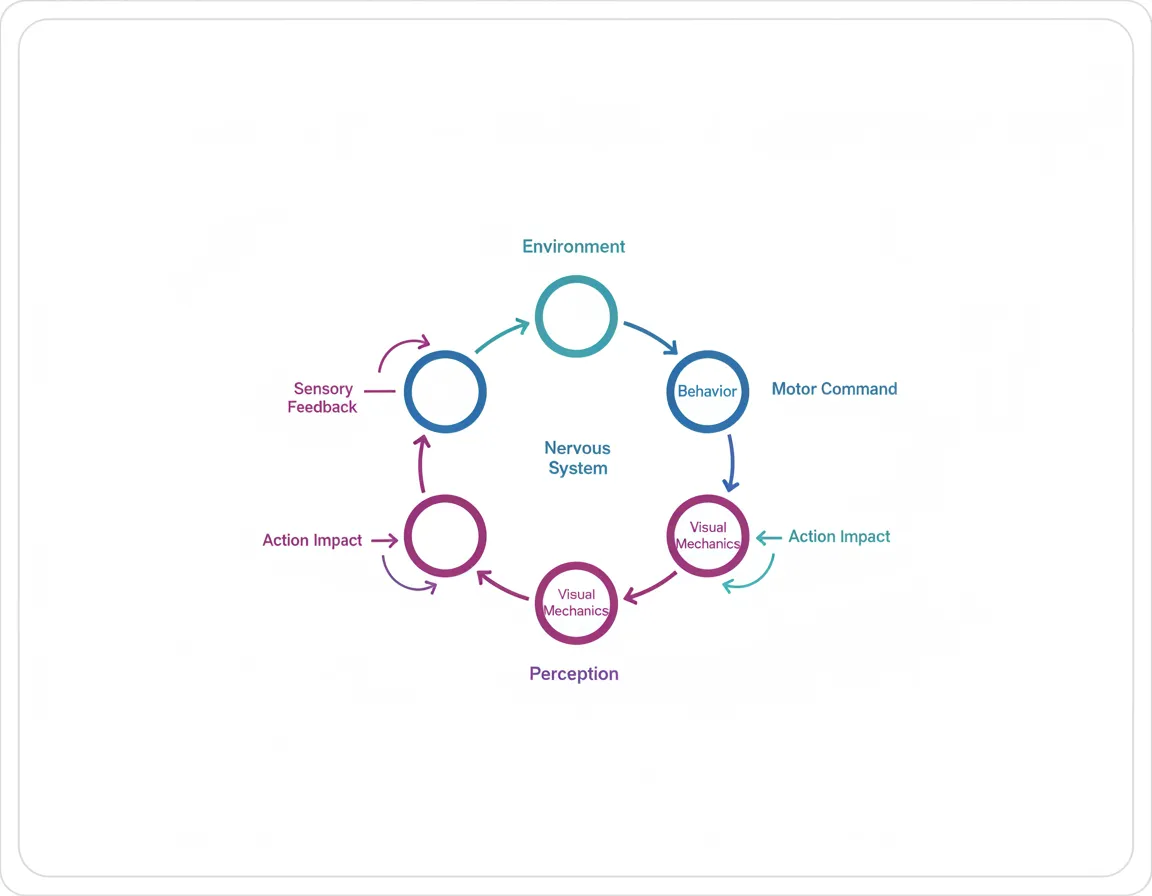
A schematic of how environment, behavior, nervous system, mechanics, and perception form a regulatory loop.
3) From Load to Pattern: Why the 5 Patterns Exist
Under chronic load, the system often converges toward one dominant strategy: • Performance-Driven Fatigue: high cognitive demand → high precision effort → fatigue and instability • Stress-Contraction: autonomic tension → increased muscle tone → reduced flexibility • Accommodation Rigidity: long near-focus dominance → slower near–far shifting • Digital Dominance: screen ecology → blink/attention/focus narrowing → strain and dryness • Progressive Compensation: long-term coping habits → effortful clarity → entrenched inefficiency
Embed diagram: 5 Adaptive Vision Patterns Wheel
Performance-Driven Fatigue
High cognitive demand and precision effort keep the system working hard for clarity, until it tips into fatigue and instability.
High loadStress-Contraction
Autonomic tension increases muscle tone and reduces flexibility, so small changes in load feel disproportionately hard.
Tension-ledAccommodation Rigidity
Long near-focus dominance makes near–far shifts slower, so distance work feels effortful or delayed.
Near biasDigital Dominance
A screen-centric ecology narrows blink, attention, and focus, driving strain, dryness, and narrowed range.
Screen ecology4) Evidence Domains We Integrate
Hack Your Vision integrates research across five relevant domains. We do this deliberately because vision is a multi-level phenomenon.
A) Visual Neuroscience & Perception
Perception is constructed—not just received. Attention and prediction shape what becomes “clear.” Implication for training: We can improve clarity by training how perception stabilizes under load, not only by forcing the optics.
B) Perceptual Learning & Plasticity
Perceptual performance can change through structured practice (task-specific improvements, threshold shifts, efficiency gains). Implication for training: Repeated, well-designed visual tasks can increase discrimination, stability, and endurance.
C) Stress Physiology & Autonomic Regulation
Arousal state influences muscle tone, attention narrowing, and sensory processing efficiency. Implication for training: Regulation practices can reduce unnecessary effort and restore flexibility, especially in Stress-Contraction and Performance-Fatigue profiles.
D) Digital Eye Strain & Visual Behavior
Screens alter blink behavior, near-focus exposure, eye movement patterns, and attentional load. Implication for training: We treat screen life as an ecology to manage—not an enemy to fear. We restore range: distance, variability, recovery cycles.
E) Light Environment & Visual Ecology
Light is not just illumination; it shapes arousal rhythms, behavior, and visual ecology. Implication for training: We design interventions that leverage natural light, distance exposure, and variability as regulatory inputs.
5) What We Measure (and Why)
Most people measure vision like a snapshot. Hack Your Vision measures vision like a system under load.
Level 1 — Assessment (2 minutes)
Identifies dominant pattern via: • symptom dynamics (when it worsens) • exposure profile (screens/near work) • focus behavior (near–far shifting) • recovery profile (sleep/fatigue linkage) Output: pattern + first-step strategy.
Level 2 — Baseline Mapping (1:1)
A structured diagnostic map of: • visual habit loops (compensation patterns) • load spikes (work blocks, environments) • flexibility markers (near–far response) • environmental drivers (light, distance, setup) • regulation drivers (stress rhythms, recovery capacity) Output: root cause map + 14–30 day plan.
Level 3 — Longitudinal Training Metrics (Programs / AI Coach)
Tracking focuses on change over time: • clarity stability across the day • fatigue onset time (how long until symptoms) • near–far transition time • screen tolerance • subjective comfort + functional performance markers Principle: The primary indicator is stability-under-load, not only “best possible clarity.”
6) What We Claim (and What We Don’t)
We claim • Visual symptoms are often shaped by load + regulation. • Many people can improve comfort, stability, and focus flexibility through training. • Patterns are actionable: each has a different strategy. We do not claim • This is a medical diagnosis. • Guaranteed refractive reversal for everyone. • Replacement of eye care.
Micro disclaimer (simple): Hack Your Vision is educational and training-based. For medical concerns, consult an eye-care professional.
Educational, training-first — not a replacement for medical care.
We stay anchored in functional outcomes and pattern-guided training. Structural and diagnostic questions belong with your eye-care professional.
7) How Research Translates Into Programs
Research isn’t here to impress. It’s here to guide design.
Adaptive Vision Reset Protocol
Targets: load reduction + flexibility restoration Best for: Digital Dominance, Stress-Contraction, Performance-Fatigue (early)
30-Day Adaptive Vision Reset
Targets: accommodative flexibility + endurance + stabilization Best for: Accommodation Rigidity, mixed patterns
AI Vision Coach
Targets: adherence + feedback + daily load management Best for: screen-heavy lives that need structure
Mentorship / Root Cause
Targets: entrenched compensation loops + personalized strategy Best for: Progressive Compensation, complex cases
8) Start With Your Pattern
If you want the fastest way to apply this model: Take the 2-Minute Adaptive Vision Assessment Results appear instantly.
FAQ (Research Page)
Common questions about how the Adaptive Vision Regulation model fits alongside traditional eye care and training.
Is this “natural vision”?
Hack Your Vision is not built on belief or tradition. It’s built on a regulatory/perceptual model: load → adaptation → pattern → training.
Do you claim structural change?
We focus first on functional outcomes: stability, comfort, flexibility. Structural questions require separate measurement and longer timelines.
Why not just “do eye exercises”?
Because different patterns require different strategies. Wrong intervention at the wrong time often increases frustration.