
The Science Behind Adaptive Vision Regulation
Vision is not only optics.
Vision is perception — and perception is regulated.
Hack Your Vision is built on a simple premise:
Visual clarity and comfort are influenced by how the visual system adapts under load—including environment, behavior, nervous system state, and visual mechanics.
This page explains the framework, what we measure, what we claim (and what we don’t), and where the evidence comes from.
The Regulatory Vision Model
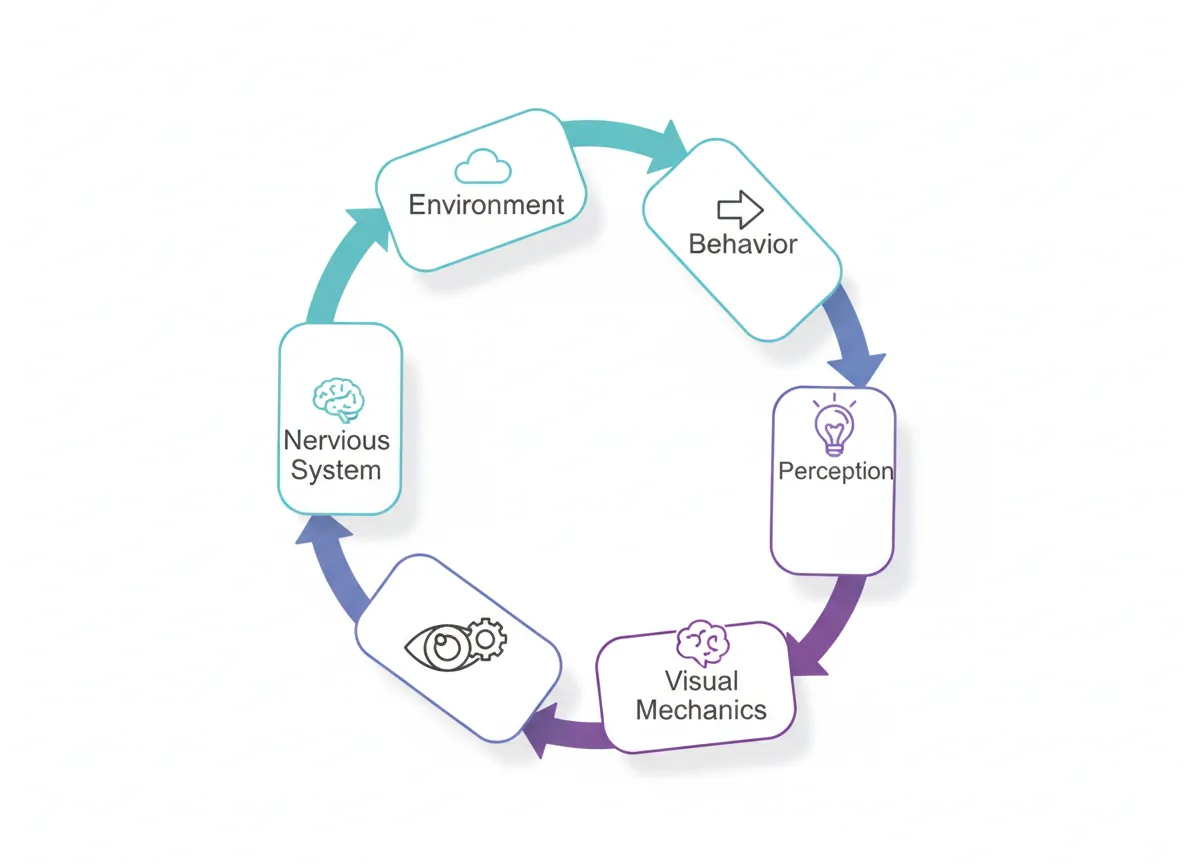
Visual perception emerges from a feedback loop:
Environment → Behavior → Nervous System → Visual Mechanics → Perception → (back to Behavior)
When load exceeds adaptive capacity, the system stabilizes into recognizable patterns (e.g., Digital Dominance, Stress-Contraction).
See the Visual Regulation Diagram (embed diagram)
What We Claim (and What We Don’t)
We claim:
- Visual symptoms often reflect adaptive regulation under load.
- Patterns can be identified using behavioral and environmental markers.
- Training can improve visual flexibility, comfort, and endurance through structured habit + perception work.
We do not claim:
- This is a medical diagnosis.
- Guaranteed reversal of refractive error for everyone.
- Replacement of clinical eye care.
Hack Your Vision is an educational, training-based framework designed to improve functional visual performance.
Key Domains Informing the Framework
Visual Neuroscience
How attention, prediction, and cortical processing shape perception.
Perceptual Learning
How repeated perceptual tasks can change performance over time.
Stress Physiology
How autonomic state and cognitive load modulate sensory processing.
Digital Visual Load
How screens change blink behavior, near-focus exposure, and attentional patterns.
Light Environment
How indoor vs outdoor light shapes visual ecology and arousal rhythms.
What We Measure (Practical + Research-Ready)
Depending on tier (assessment → baseline mapping), we track:
- symptom dynamics (fluctuating clarity, fatigue timing)
- digital exposure + near-distance dominance
- focus flexibility markers (near–far transitions)
- attention/narrowing patterns
- recovery capacity (how quickly symptoms resolve)
References Library
We maintain a curated library organized by:
- Digital Eye Strain & Visual Fatigue
- Perceptual Learning & Plasticity
- Stress/Autonomic Regulation & Perception
- Light Environment & Visual Function
- Measurement & Experimental Designs
Explore Our Blog & Join the Newsletter
Get practical tips, research highlights, and updates delivered to your inbox. Read in-depth articles or subscribe for weekly insights.
Start with Your Focus Pattern
If you want the simplest entry point:
Take the 4-Minute Adaptive Vision Assessment
Results appear instantly.